


Associate Education Minister David Seymour. Photo: RNZ / Mark Papalii
The Education Ministry says the English and maths curriculums introduced by primary schools this year have had a bigger impact than expected.
Appearing before Parliament's Education and Workforce Select Committee, the ministry's chief executive, Ellen MacGregor-Reid, said she was thrilled for children.
"The results have exceeded my expectations. We'd been working for some time on structured literacy as an approach, we'd identified for some time we had issues in mathematics teaching. The investment that has been made in recent years has outstripped my expectations in terms of what we are now seeing coming through for children," she said.
Asked why it did not move faster, she said: "We took a while working with people, working with the sector getting buy-in. My reflection in hindsight is while that worked, a short amount of time in the life of an adult is a long time in the life of a child. So that's my overall reflection is we need to get the right balance between getting changes to occur in the classroom but making it manageable for the teachers and leaders."
Asked if introducing the new primary school English and maths curriculums quickly had been the right decision, MacGregor-Reid said "For maths and literacy, yes, it was the right decision and I think our teaching profession has done themselves proud".
MacGregor-Reid said she had heard anecdotal reports of children telling their teachers and others that maths was their favourite subject.
"That's a big thing for this country," she said.
MacGregor-Reid held out some hope for schools and early childhood services facing big bills for cleaning up asbestos contamination from colour sand.
She said the ministry was looking at "some options" but had not made any decisions.
Questions overs free lunch scheme
Later in the hearing, Associate Education Minister David Seymour appeared before the committee and Labour Party education spokesperson Willow-Jean Prime challenged him over complaints about the cut-price free school lunch scheme.

Labour Party education spokesperson Willow-Jean Prime. Photo: RNZ / Samuel Rillstone
"At what point after a child has been burnt, another has bitten into plastic, bugs have been served up in lunches, will you concede that this programme has been a flop," she asked him.
"About the same time as you get an Oscar for that performance," Seymour responded.
Prime suggested Seymour bullied people who criticised the lunch programme.
"This is supposed to be an exercise in evaluating value for taxpayer money, if you're looking for another career as an actor then I don't like your chances," Seymour said.
That prompted Labour's Phil Twyford to interject.
"Give it a rest. Jerk," he said.
Education Minister Erica Stanford also appeared before the committee and was challenged over the government's decision to cancel schools' legal obligation to uphold the Treaty of Waitangi.
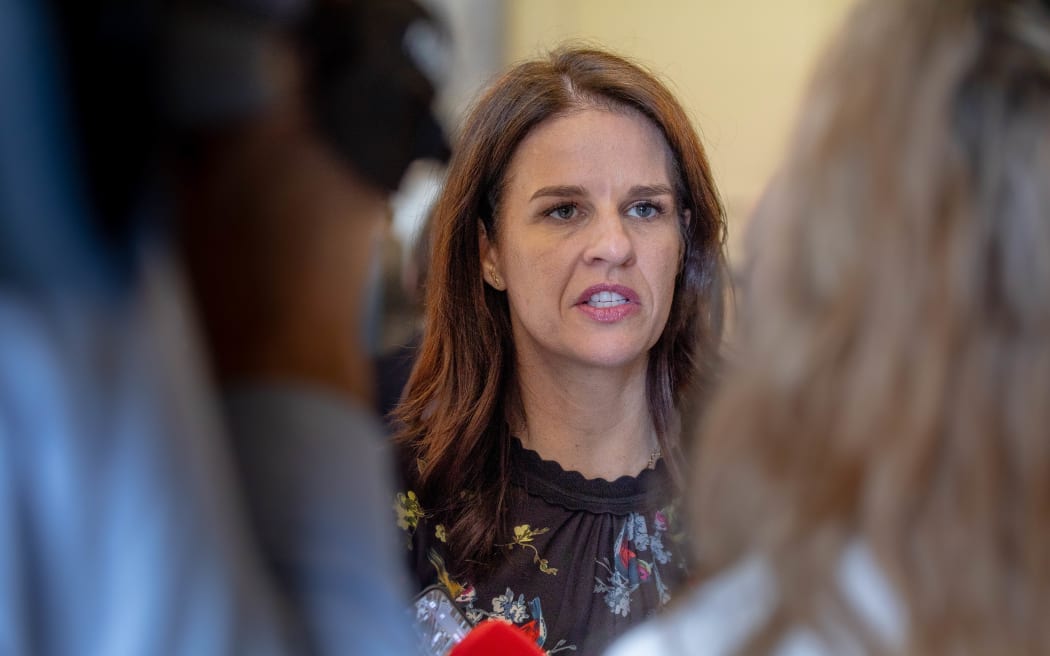
Education Minister Erica Stanford. Photo: RNZ / Mark Papalii
She denied the 1500 schools that had since publicly affirmed their commitment to the treaty was proof the government got it wrong.
"We always said it is up to schools if they wish to confirm that. As long as they are doing the things that we ask of them which are very clearly laid out - raise Māori achievement, offer te reo Māori, and be culturally responsive. Over and above that, if schools wish to uphold the treaty as many have reconfirmed their position, then they are free to do so," she said.
Stanford said the government's reforms were having a positive effect and the biggest improvements were among Māori and Pacific students.
Sign up for Ngā Pitopito Kōrero, a daily newsletter curated by our editors and delivered straight to your inbox every weekday.